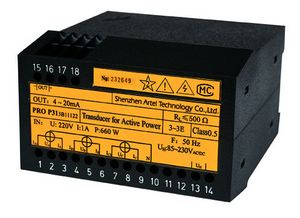
PRO Traditional Transducer
The PRO traditional transducer series from LOGGON TECH is a family of signal converters that turn AC current and voltage into proportional, galvanically isolated DC signals for control and monitoring systems. The range is built around single-function modules — the I31 AC current transducer and the U31 AC voltage transducer — and multi-channel versions that consolidate two or three measuring circuits into one housing (PRO I32/I33, PRO U32/U33). Each PRO traditional transducer is manufactured in Shenzhen, China, and carries the Artel trademark. The series is intended for engineers who need a predictable analog interface between the power circuit and the automation layer.
What it measures and does
The I31 converts an AC current into a proportional DC current or voltage output, with isolation between the measured circuit and the output. The U31 performs the same function for AC voltage, using transformer isolation for the conversion path. In both cases, the output is a continuous analog signal that tracks the measured quantity linearly over the working range, so a PLC or DCS analog input card reads the value directly after range scaling.
The multi-channel members follow a simple consolidation logic. The two-in-one PRO I32 integrates two I31 circuits in a single housing: it accepts three-phase current input and provides three isolated outputs. The three-in-one PRO I33 extends the same principle to a three-channel configuration. On the voltage side, the two-in-one PRO U32 and three-in-one PRO U33 group two or three U31 circuits respectively. The choice between single and multi-channel housings is a panel-space and wiring decision rather than a functional one: the conversion role of each channel is identical. Isolation matters in every variant. It separates the measured circuit from the low-voltage signal loop, which limits fault propagation into the control cabinet and prevents ground loops between the power side and the analog input card. Typical signal destinations are PLC and DCS analog input modules and panel meters; the proportional DC current or voltage output is suited to both.
Key features
- Proportional DC current or voltage output for each measured circuit, suitable for direct connection to analog input cards.
- Galvanic isolation between the measured AC circuit and the output signal.
- Transformer-isolated voltage conversion on the U31 and its multi-channel variants.
- Single-channel I31/U31 modules for one measuring circuit per housing.
- Consolidated housings: PRO I32 (two I31 circuits, three-phase current input, three isolated outputs), PRO I33, PRO U32 and PRO U33 for multi-channel panels.
- Artel trademark, Shenzhen, China; supplied through LOGGON TECH.
Specifications
The table below covers the documented family data: model members and their conversion roles. Numeric ratings are not listed here; obtain the current and voltage ranges, output range, accuracy, and isolation level from the product datasheet before ordering.
| Model | Type | Conversion role |
|---|---|---|
| I31 | AC current transducer | Converts AC current into a proportional DC current/voltage signal with isolation |
| PRO I32 | Two-in-one, AC current | Two I31 integrated in a single housing; three-phase current input; three isolated outputs |
| PRO I33 | Three-in-one, AC current | Consolidated three-channel AC current conversion (see datasheet) |
| U31 | AC voltage transducer | Transformer-isolated voltage conversion to a proportional DC signal |
| PRO U32 | Two-in-one, AC voltage | Two U31 circuits in a single housing |
| PRO U33 | Three-in-one, AC voltage | Three U31 circuits in a single housing |
| Origin | Shenzhen, China; trademark Artel | |
Options and configuration
Configuration is carried out at the model-selection level. First, decide whether the panel needs a current transducer, a voltage transducer, or both. Second, consider the housing: the PRO I32 integrates two I31 units and accepts three-phase current input with three isolated outputs; confirm the circuit and channel mapping for each multi-channel housing from the datasheet before ordering. Third, confirm the measured range and the required output form (DC current or DC voltage) against the datasheet, and check that the receiving analog input card accepts that signal. Because the family provides no numeric ratings in the general catalogue data, the datasheet is the controlling document for every ordering decision.
Applications
The series is used where an AC power quantity must reach an automation system as an analog value. Typical installations include switchgear and distribution panels feeding PLC analog inputs, DCS marshalling cabinets in process plants, and panel-meter circuits where a local indication is driven from the same isolated signal. The single-channel I31 and U31 suit retrofit work in existing cabinets; the PRO I32, PRO I33, PRO U32, and PRO U33 suit new builds where panel space and terminal count are planned in advance. Because each output is isolated, transducers for different circuits can feed the same input card without creating ground loops, provided the card's input configuration supports it.
FAQ
What is the difference between the I31 and the PRO I32?
The I31 is one AC current conversion circuit in its own housing. The PRO I32 integrates two I31 circuits in a single housing, accepts three-phase current input, and provides three isolated outputs. Electrically, each channel performs the same current-to-DC conversion with isolation; the difference is packaging and channel count.
Do I need a separate transducer for each phase?
Not necessarily. For three-phase current, the two-in-one PRO I32 combines the required channels in one housing with three isolated outputs. Alternatively, three separate I31 modules can be used when wiring layout or spare-part practice favors single-channel units.
What does the output connect to?
The proportional DC current or voltage output is intended for PLC or DCS analog input modules and for panel meters. Check the input range of the receiving device against the datasheet output specification before commissioning.
Is isolation provided on every model?
Isolation between the measured circuit and the output is part of the conversion role across the family; the voltage members use transformer-isolated conversion. The datasheet states the isolation specification for each model.
For current and voltage ranges, output specifications, accuracy, and isolation ratings, request the PRO traditional transducer datasheet via the contact page, or send your circuit details to LOGGON TECH for a model recommendation.