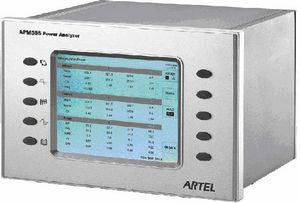
Power Quality Analyzers for Industrial Power Distribution
A power quality analyzer is a diagnostic instrument used to measure, record and evaluate the voltage and current conditions on an electrical supply. Disturbances such as voltage sags, swells, interruptions, flicker and unbalance are not visible on a standard multimeter, yet they are the conditions most often responsible for contactor drop-out, drive trips and unexplained resets on plant equipment. LOGGON TECH supplies the APM556 power quality analyzer for engineers who need to verify supply conditions at a specific point in the distribution system, classify the events found there against IEC power quality standards, and retain the records for reporting and follow-up. The instrument combines waveform display, harmonic analysis and triggered event recording in a single unit with a large-size LCD touchscreen and multiple communication ports.
Category overview and where power quality analyzers are used
Power quality work divides into two modes. Fixed monitoring is installed permanently at a busbar or incoming feeder and collects data continuously. Portable analysis is taken to a point of interest for a defined period: a troubleshooting visit, a commissioning check, an energy audit or an investigation following repeated equipment failure. The APM556's documented functions — harmonic analysis, event capture and waveform display — suit this survey-style work.
Typical applications include:
- Incoming supply verification at a transformer or main switchboard before new loads are connected.
- Investigating nuisance tripping of variable frequency drives, PLCs and contactors where the cause is not a fault in the equipment itself.
- Checking neutral and phase current conditions on distribution boards serving non-linear loads such as rectifiers, LED drivers and office IT equipment.
- Recording supply events during a production trial so that a disturbance can be correlated with a process stop.
- Audit work where the supply system must be shown to comply with IEC power quality limits.
Because the same instrument measures basic electrical parameters, displays waveforms and trend graphs in real time, and records events, a single visit can move from a general check to a specific investigation without a change of equipment. For work dominated by distortion rather than events, the same unit operates as a harmonic analyzer, identifying the order and magnitude of harmonic components on voltage and current channels.
Models in this range
APM556 power quality analyzer
The APM556 is the model in this range. Its functions, as specified by the manufacturer, are:
- Basic electrical parameter measurement.
- Real-time display of waveforms and trend graphs on a large-size LCD touchscreen.
- Harmonic measurement and analysis.
- Event recording with triggered storage, covering voltage sags (dips), swells, interruptions, flicker, and voltage and current unbalance.
- Judgement of supply system power quality against IEC standards.
- Multiple communication ports, with the option to network the unit with power quality management software to form a management system.
The APM556's documented functions — measurement, waveform and trend display, event recording and networking — serve troubleshooting, audits and ongoing monitoring at a point. Detailed channel counts, memory capacity and accuracy class are not stated in this summary; request the current datasheet for these parameters before specifying the unit against a particular measurement task.
How to select a power quality analyzer
Selection starts from the question the instrument must answer. Where the problem is a transient event, for example and the objective is to capture what happened at the instant a drive tripped, event recording with triggered storage is the decisive function. Where the concern is waveform distortion from non-linear loads, harmonic measurement and analysis matter more. The APM556 covers both, which reduces the number of instruments required across a maintenance team.
Practical selection points:
- Measurement objective. Event capture, harmonic survey, or general parameter logging. Confirm the instrument records the specific phenomena you are investigating: sags, swells, interruptions, flicker, unbalance.
- Compliance reference. If the output must be judged against IEC power quality standards, confirm the instrument performs this evaluation rather than only logging raw data.
- On-site readability. Waveform and trend display on the instrument allow a conclusion during the visit instead of after post-processing. Screen size and touch operation affect how practical this is in a switchroom.
- Portability. For call-out work across several substations, confirm the unit's enclosure format before selecting it for portable use; a fixed monitor suits permanent points.
- Data path. Decide in advance whether records stay on the unit, are exported for a report, or feed a networked management system. This determines which communication ports and software you need.
- Safety and connection. Confirm the voltage and current connection method suits the panels you will open, and that the installation category of the instrument is appropriate for the point of measurement.
Do not select on screen size or port count alone. Match the recorded phenomena and the compliance evaluation to the investigation, then check the datasheet figures for the channels and accuracy you require.
Integration and communication
The APM556 provides multiple communication ports and can be networked with power quality management software to form a management system. In practice this means recorded events and measured parameters can move from the instrument into a central record rather than remaining on the device. For plant buyers, the relevant questions are which ports are fitted, which protocols they support and what the software requires; these should be confirmed against the current datasheet and software documentation.
A common arrangement is to use the analyzer at a point for investigation and audits, then rely on fixed monitoring for continuous coverage of critical feeders. Where the APM556 is networked, agree the data ownership and reporting workflow with the maintenance or electrical team before installation, so that recorded events are reviewed and closed out rather than accumulating unread.
FAQ
What is the difference between a power quality analyzer and a multimeter?
A multimeter gives an instantaneous reading of RMS voltage, current and similar parameters. A power quality analyzer records conditions over time, displays waveforms, and captures events such as sags, swells, interruptions, flicker and unbalance that a multimeter will not register. The APM556 also performs harmonic measurement and analysis and judges supply quality against IEC standards.
Can the APM556 be used as a harmonic analyzer?
Yes. Harmonic measurement and analysis is one of the specified functions of the APM556, alongside basic parameter measurement, waveform and trend display, and event recording. For a survey of distortion on a distribution board serving non-linear loads, this function is the relevant one.
Is this a portable unit or a fixed monitor?
The published data establishes the APM556's measurement and event-recording functions, which suit troubleshooting and audits at a point; its enclosure and mounting format are confirmed against the current datasheet. It can be networked with power quality management software to form a management system, so recorded data can still be brought into a central record.
Which specifications should I confirm before ordering?
Confirm the parameters not stated in this overview: channel count, memory capacity, accuracy class, the exact communication ports and supported protocols, and the software version required for networking. Provide the measurement point, the phenomena to be recorded and the IEC standard you are working to, and request the current datasheet from LOGGON TECH for verification.
For specification of the APM556 against a specific investigation, send LOGGON TECH the measurement point, the events or distortion you need to record, and the standard you are working to. The manufacturer can then confirm the configuration and the communication arrangement that fit the task.