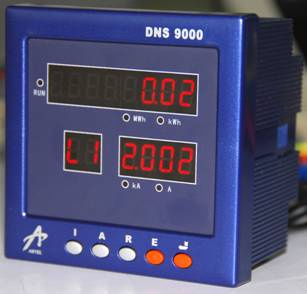
Energy meter selection for industrial metering and sub-billing
An energy meter used in industrial and commercial installations has to do more than totalise kilowatt-hours. It must measure active, reactive and combined energy accurately across single-phase, three-phase three-wire and three-phase four-wire circuits, tolerate unbalanced loads, and make the data available to a monitoring or billing system. The DNS 9000 series digital energy meter is supplied through LOGGON TECH for these duties, covering real-time current, kWh and kvarh measurement with multi-tariff metering and several communication and signalling options. This page sets out the range, the selection criteria that matter at the specification stage, and the integration points an electrical engineer or plant buyer needs to confirm before ordering.
Category overview: where these energy meters are applied
The DNS 9000 series is intended for secondary metering in both high-voltage and low-voltage systems; the connection arrangement and any transformer requirements follow the selected model's wiring documentation, with CT and VT ratios matched to the meter configuration where transformers are used. Typical applications are:
- Internal allocation between departments, production lines or buildings on a single site.
- Tenant metering in multi-occupied industrial or commercial premises, where each tenant is charged against a measured consumption record.
- Energy cost accounting, where consumption is attributed to cost centres or products for internal reporting.
- Reactive energy recording where power factor correction or tariff penalties make kvarh a chargeable quantity.
Because the range supports single-phase, three-phase three-wire and three-phase four-wire configurations, one model line can serve a mixed distribution board population: lighting and small power circuits, motor control centres and main incomers can all be metered from the same series. When specifying a three phase energy meter for an unbalanced load, confirm that the meter measures each phase independently rather than assuming a balanced system; the DNS 9000 series is documented for unbalanced load conditions.
Models in this range
The line is designated DNS 9000 series digital energy meter, with model numbers DNS 9000, DNSS 9000 and DNS(X) 9000. All variants measure active, reactive and combined energy, and provide real-time measurement of current, kWh and kvarh. The series' documented fit-out options include:
- DNS 9000 — multi-tariff metering, energy pulse output, and RS485 with MODBUS protocol for polling by a supervisory system.
- Digital (remote signalling) input — an external status signal can be brought into the meter; how tariff switching is performed is confirmed against the documentation.
- Analog output — feeds a measured quantity to an analog indicator, PLC analog card or control loop. Which options belong to which model number is confirmed against the current datasheet at enquiry.
All variants are documented against IEC61000, IEC1010 and EN61010, and the documentation states manufacture under an ISO 9001 quality management system. Confirm the exact combination of RS485, pulse, digital input and analog output required per metering point before issuing the bill of materials, the published summary does not assign these options to individual model numbers.
How to select
Selection follows the circuit and the data requirement, in that order:
- System type and connection. Identify whether the circuit is single-phase, three-phase three-wire or three-phase four-wire. Confirm the CT count, connection arrangement and ratios against the selected model's wiring diagram, and match the meter's voltage and current input configuration to the installed CT/VT ratios.
- Voltage level. For high-voltage metering, the meter operates on the secondary side of VTs and CTs. Verify the secondary ratings and the meter's input range before purchase.
- Load balance. Where single-phase loads are distributed across a three-phase supply, specify a meter documented for unbalanced loads, as the DNS 9000 series is.
- Tariff structure. If the supply tariff separates time-of-use periods, or if reactive energy is chargeable, confirm that multi-tariff metering and kvarh registration are enabled in the ordered configuration.
- Enclosure and mounting. A din rail energy meter format suits panel space constraints in distribution boards; where a panel-mount or enclosure-mounted instrument is required, confirm the mechanical format of the specific model number with the supplier rather than assuming rail mounting.
- Verification. For internal allocation accounting, agree the accuracy class, test certificate and seal arrangement with LOGGON TECH at the enquiry stage.
Integration and communication
The RS485 port with MODBUS protocol allows the meter to be polled by a PLC, RTU or energy management gateway over a twisted-pair bus. Plan the bus as a daisy chain with termination at the ends, assign unique slave addresses, and keep baud rate and parity consistent across the segment. The energy pulse output provides a cumulative pulse train for totalisers, data loggers or legacy systems that cannot read MODBUS registers; the pulse constant must be recorded so that the receiving device scales correctly. Where fitted, the digital (remote signalling) input can carry an external status signal into the meter record, and the analog output provides a continuous signal proportional to the configured measured quantity for direct connection to analog instrumentation.
FAQ
Can the DNS 9000 series meter a three-phase four-wire circuit with unbalanced loads?
Yes. The range is specified for secondary metering of single-phase, three-phase three-wire and three-phase four-wire systems, including unbalanced loads.
Does the meter support time-of-use tariffs?
Yes. Multi-tariff metering is a standard feature across the DNS 9000 series, alongside active, reactive and combined energy registration.
What communication interface is available?
RS485 using the MODBUS protocol. An energy pulse output is also provided; digital input and analog output options are listed for the series — confirm the fit-out per model number against the current datasheet.
Which standards is the range documented against?
The meters are documented against IEC61000, IEC1010 and EN61010, and the documentation states manufacture under an ISO 9001 system.
For a plant-wide metering scheme, the practical approach is to map every metering point to a circuit type, a tariff requirement and a data destination first, then confirm which model number carries the I/O fit-out each point needs against the current datasheet. Providing LOGGON TECH with the CT/VT ratios, system configuration and communication architecture at the enquiry stage allows the model numbers and options to be confirmed against the installation rather than adjusted after delivery.