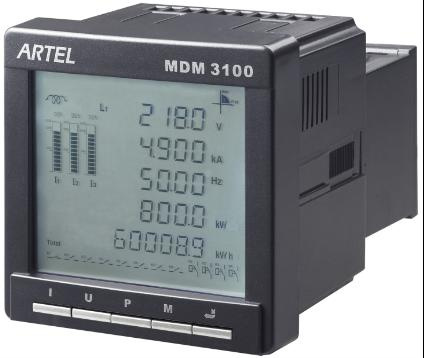
Multifunction Power Meter Range for Panel and System Integration
A multifunction power meter replaces several discrete instruments in a switchgear panel or distribution board: it samples voltage and current inputs, computes derived quantities such as power, power factor and energy, and presents them locally while reporting the same data over a serial bus. The LOGGON TECH range covers two modular panel-mounted models, the MDM3100 and the MDM3001S, both built for three-phase systems and both supporting RS-485 communication. This page summarises what each model measures, the available options, and the selection and integration points an electrical engineer or plant buyer needs to check before specifying.
Overview: where a multifunction power meter is used
These instruments are intended for panel mounting in industrial and commercial electrical installations. Typical positions include:
- Incoming feeders and sub-distribution circuits in factory main switchboards, where a three phase power meter provides the current, voltage, power and energy data used for load management and cost allocation.
- Machine and process panels, where the meter feeds a PLC or SCADA system as a modbus power meter over RS-485.
- Energy monitoring and sub-metering points, using the pulse outputs or stored energy registers for energy collection (kvarh registers are listed for the MDM3001S; the MDM3100 documents pulse outputs).
- Power factor correction and reactive power assessment, using Q, COS-PHI (MDM3100) or PF (MDM3001S) readings alongside reactive energy registers.
Both models are panel mount power meters with a modular design; confirm the cut-out and wiring for each model before reusing a panel design across a project.
Models in this range
MDM3100
The MDM3100 is a modular panel-mounted multifunction meter. It measures phase voltage U, current I, active power P, reactive power Q, apparent power S, power factor COS-PHI, frequency F, active energy kWh; for reactive energy it documents pulse outputs (the manufacturer's capture lists the entry as kVAr), with register availability confirmed in the datasheet.
Standard configuration:
- RS-485 communication
- Two energy pulse outputs (active and reactive)
- Maximum/minimum value recording
- SOE (sequence of events) event records
Optional modules:
- Harmonic analysis
- 8 digital inputs
- 4 programmable analog outputs (0-5 V or 4-20 mA)
- Data storage
- Profibus
- Ethernet
Up to four modules can be fitted per meter (MDM3100 figure per its historical catalogue). For the MDM3100, the manufacturer's historical catalogue lists an auxiliary supply of 85-265 VAC/DC as standard, with optional 24-36 VAC/DC or 36-80 VAC/DC variants; the MDM3001S supply is confirmed against its own current datasheet. These configuration figures should be confirmed at the time of order.
MDM3001S
The MDM3001S is a modular panel-mounted meter measuring voltage U, current I (including neutral current In), frequency F, apparent power S, active power P, reactive power Q, power factor PF, active energy kWh and reactive energy kvarh.
- RS-485 communication with Modbus protocol
- Maximum/minimum value recording
- Analog output
- Digital input
- Multi-tariff energy metering
The model is documented against IEC61000 for EMC and IEC1010/EN61010 for safety isolation, and its documentation states that it is developed, manufactured and tested under an ISO 9001 quality assurance system.
How to select between the two models
Selection normally starts from the quantities the installation must record and the signals the control system must receive.
- Measurement set. If the project requires COS-PHI measurement or SOE event logging, the MDM3100 covers these in its standard configuration. For documented kvarh registration, the MDM3001S is the documented choice; the MDM3100 documents reactive-energy pulse outputs, with register availability confirmed in its datasheet. If neutral current In, multi-tariff energy accounting and PF are the priorities, the MDM3001S matches that requirement.
- I/O and protocols. The MDM3100 offers a wider module range: harmonics, digital inputs, analog outputs, data storage, Profibus and Ethernet, up to four modules (per the historical catalogue). Confirm which combination the installation needs, and note that the module set must be fixed at ordering.
- Analog interfacing. Where a PLC or recorder expects 0-5 V or 4-20 mA, the MDM3100 analog output module provides four programmable channels. The MDM3001S provides an analog output as a listed feature; check its range and channel count in the datasheet.
- Control supply. The MDM3100's historical catalogue lists a wide auxiliary supply (85-265 VAC/DC standard; 24-36 / 36-80 VAC/DC options); verify the supply for the exact model against its current datasheet before ordering.
- Panel space and wiring. Confirm the cut-out dimensions, terminal arrangement and CT/VT ratios against the drawing package, and check that the shorting terminals and fusing practice on the current inputs follow site standards.
Integration and communication
Both models provide an RS-485 port, making either a power meter with RS485 suitable for multi-drop networks in a switchboard. Practical integration points:
- On a Modbus segment (the MDM3001S documents Modbus), set a unique slave address and matching baud rate and parity for each meter; for the MDM3100, follow its RS-485 documentation. Keep the trunk within the segment limits and terminate at the physical ends.
- Use screened twisted-pair cable for the RS-485 trunk and route it separately from power and switching cables to reduce induced noise.
- Map the required registers in the PLC or gateway: voltage, current, power, power factor and energy. Multi-tariff registers on the MDM3001S need a defined tariff-switching scheme.
- Where the MDM3100 is fitted with Ethernet or Profibus, plan the network addressing and the data mapping into the SCADA or DCS at the design stage.
- For energy billing or verification, cross-check the pulse output constant against the meter's kWh register during commissioning.
FAQ
Can both models be used on three-phase systems?
Yes. Both are three-phase instruments measuring phase voltage, current and the derived power quantities listed above. Confirm the wiring mode (three-phase four-wire or three-wire) against the actual system before commissioning.
Which model should I choose for Modbus energy monitoring?
The MDM3100 provides RS-485 communication; the MDM3001S provides RS-485 with Modbus. The MDM3001S adds multi-tariff energy metering, while the MDM3100 adds SOE records, pulse outputs and a wider module range. Choose according to the data and I/O schedule.
Are the optional modules field-fitted?
The MDM3100 accepts up to four modules (per the historical catalogue). Because the module set affects the configuration, specify the required combination at the ordering stage and confirm fitting arrangements with the manufacturer.
What documentation is available?
The MDM3001S is documented against IEC61000 and IEC1010/EN61010, and the MDM3001S documentation states development, manufacture and testing under an ISO 9001 quality assurance system. Request the current datasheet and wiring diagram for the exact model and option set.
For a firm specification, send the system voltage, CT ratio, required measured quantities, communication protocol and I/O count to LOGGON TECH. The manufacturer will confirm the model, module configuration and auxiliary supply variant against the current catalogue data.