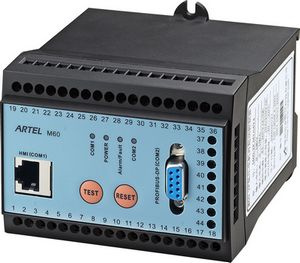
Motor Protection Relays & Controllers for Low-Voltage Asynchronous Motors
A motor protection relay combines three functions that are often supplied as separate devices: measurement of motor electrical parameters, protection against abnormal operating conditions, and control of the starting and stopping sequence. LOGGON TECH supplies relay- and controller-class devices for low-voltage asynchronous motors. The range includes the traditional M60 protection controller (motors below 800 A at 380 VAC, 50 Hz) and the current LOGGON-500 motor protector series (380 V, 1–800 A). This page describes both generations, the protection functions available in each model, and the criteria used to select a motor protection device for a given installation.
Category overview: where a motor protection controller is used
An electric motor protection device is applied wherever a low-voltage asynchronous motor drives a load whose failure mode is costly or whose operating condition cannot be observed directly. Typical installations include pumps, fans, compressors, conveyors, mixers and machine-tool drives in water treatment, HVAC, building services, material handling and general industrial plants. In these installations the motor protection controller is mounted in the motor control centre or a local control panel, receives current signals from external current transformers, and operates a contactor or a breaker shunt release when a protection threshold is exceeded.
Terminology matters when specifying. This page covers relay/controller-class devices that measure, protect and control. Breaker-type motor protectors integrate protection into the switching device itself, and thermal overload relays provide a thermal model only, without measurement or control functions. A relay-class motor protector is chosen when parameter visibility, remote communication, event records or programmable starting control are required in addition to overload protection.
Models in this range
M60 traditional protection controller
The M60 provides full protection and control for low-voltage asynchronous motors rated below 800 A, 50 Hz, 380 VAC. It measures motor electrical parameters, performs operating control, manages history records and supports remote communication. Four variants are documented: M60-1S, M60-3S (standard), M60-2M (popular) and M60-2P (integrated). The design references GB/T 14048.4-2003, IEC 947 and JB/T 10613-2006.
LOGGON-500 series: LOGGON-3S intelligent protection controller
The LOGGON-3S is an intelligent protection controller within the LOGGON-500 motor protector series, which is positioned as a complete low-voltage motor protection scheme for 380 V, 1 A to 800 A applications. Its protection functions cover start timeout, short circuit, locked rotor, tE time, overload, unbalance, underload, thermal overload, process interlock and grounding. Record functions include alarm records, trip records, maximum and minimum parameter values captured during the protection action, and cumulative motor running time.
LOGGON-500 series: LOGGON-2M
The LOGGON-2M carries the wider documented protection set: start timeout, short circuit, stall (locked rotor), tE-time, overload, imbalance, under-voltage, over-voltage, underload, thermal overload, leakage, process interlock, grounding, over-power, under-power and phase reversal, plus anti-sag restart after a stop caused by a supply dip. Control functions include direct, forward/reverse, reduced-voltage and star-delta starting, selectable local or remote operation. The 2M records contactor operation counts, running time, and alarm, fault, restart and start-stop records.
LOGGON-500 series: LOGGON-3L line protection controller
The LOGGON-3L is a line protection controller. It provides under-voltage and over-voltage protection, overload protection, three-stage overcurrent protection and leakage protection, together with local and remote opening and closing control. Fault trip, alarm and switching records are stored at 10 entries each, with timestamps.
How to select
Selection starts from the motor nameplate and the process it drives, not from the model list. The following points determine which motor protection relay fits an application:
- Rated current and voltage. Confirm the motor full-load current and supply voltage against the device range. The LOGGON-500 series covers 380 V, 1 A to 800 A; the M60 covers motors below 800 A at 380 VAC, 50 Hz.
- Required protection functions. Overload and short circuit protection are the baseline. Add unbalance, underload, grounding, tE time or locked rotor where the load or process demands it. Select the LOGGON-2M when voltage, power, power factor, phase-reversal or leakage protection is required.
- Starting method. Direct-on-line is sufficient for most small and medium motors. Forward/reverse, reduced-voltage or star-delta starting requires a controller with the corresponding control outputs, such as the LOGGON-2M.
- Control location. Decide whether the motor protection controller must accept local panel commands, remote commands, or both.
- Records and Diagnostics. Trip records, alarm records and captured maximum/minimum values shorten fault finding. The 3L stores 10 entries each for fault trip, alarm and switching events with timestamps.
- Supply conditions. Where voltage dips are frequent, anti-sag restart on the LOGGON-2M avoids unnecessary manual restarts after a dip-caused stop.
- Communication. Confirm the protocol and physical interface required by the plant control system before ordering.
Integration and communication
Relay-class devices are installed in the motor control centre and wired to external current transformers on the motor feeder. The controller output operates the contactor coil or the breaker shunt release; digital inputs accept remote start/stop and process interlock signals. The M60 supports remote communication, and the LOGGON-500 series provides local and remote control on the 2M and 3L models. Protocol, interface type and wiring details are confirmed against the product manual for the selected model during detailed engineering.
FAQ
What is the difference between a motor protection relay and a thermal overload relay?
A thermal overload relay provides a thermal model of the motor and trips on sustained overcurrent. A motor protection relay measures electrical parameters and adds short circuit, unbalance, locked rotor, grounding and other protection functions, plus control outputs and event records.
Which model should be used for star-delta starting?
The LOGGON-2M supports direct, forward/reverse, reduced-voltage and star-delta starting, with local or remote operation. The starting method required by the motor and process determines the choice.
Can the controller restart the motor automatically after a voltage dip?
The LOGGON-2M provides anti-sag restart after a stop caused by a supply dip. Whether this function is enabled depends on the process and the plant safety policy.
What records are available for fault analysis?
Depending on the model: alarm and trip records, maximum and minimum parameter values during the protection action, cumulative running time, contactor operation counts, and start-stop records. The LOGGON-3L stores 10 entries each for fault trip, alarm and switching events, timestamped.
For specification work, confirm the motor full-load current, supply voltage, starting method and required protection set against the model tables above. LOGGON TECH supplies both the M60 protection controller and the LOGGON-500 motor protector series, so a single project can use relay-class electric motor protection across feeders of different ratings