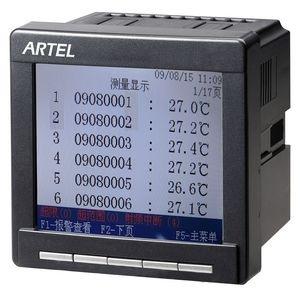
The ARZ-1 wireless temperature humidity system is a monitoring package for electrical equipment and rooms where running sensor wiring to each measurement point is impractical. Each system consists of a wireless temperature probe, a humidity probe and a display terminal. The probes transmit measured values wirelessly to the display terminal, where they are shown in real time and logged for on-site inspection rounds. The same terminal raises an over-limit alarm through a relay output and lets staff identify the affected alarm point quickly. Short-term temperature and humidity variation curves are shown as graphs on the display. Measured data can be uploaded via RS-485 or Ethernet to a DCS monitoring centre or an equipment management system for remote monitoring.
What the ARZ-1 wireless temperature humidity system measures and does
The system measures temperature at the points where the wireless temperature probe is installed and relative humidity in the surrounding air with the humidity probe. Both values are transmitted wirelessly to the display terminal, so no signal cable has to be routed from the measurement point back to the panel. The display terminal presents current readings continuously and supports on-site inspection rounds: staff can read the live values at the cabinet or room display terminal; installation and access arrangements are confirmed per project.
When a reading crosses a configured limit, the terminal issues an over-limit alarm and energises a relay output. The relay can be wired into an existing annunciator, PLC input or trip/alarm circuit. Because each probe reports its own value to the terminal, the alarm point can be located quickly rather than inferred from a single aggregated alarm.
The terminal also shows short-term temperature and humidity variation curves as graphs. This allows a maintenance engineer to see whether a value is stable, drifting or cycling, which is more useful than a single instantaneous reading when judging whether a joint is heating up or a room is losing humidity control. For central supervision, data is uploaded through RS-485 or Ethernet to a DCS monitoring centre or to an equipment management system, so remote monitoring can be handled by the existing plant-level system rather than a separate software stack.
Key features
- Wireless temperature probe, humidity probe and display terminal supplied as one measurement system.
- Real-time wireless transmission of measured values to the display terminal.
- On-site inspection rounds supported directly from the display terminal readings.
- Over-limit alarm with relay output for connection to external alarm or control circuits.
- Fast location of the alarm point that has exceeded its limit.
- Short-term temperature and humidity variation curves displayed as graphs.
- Data upload via RS-485 or Ethernet to a DCS monitoring centre or equipment management system.
- Remote monitoring through the plant DCS or equipment management system.
- Suited to points where wired sensors are impractical.
Specifications
| Model | ARZ-1 |
|---|---|
| Product | Wireless Temperature and Humidity Measurement System |
| Composition | Wireless temperature probe, humidity probe, display terminal |
| Display | Real-time values shown on the display terminal; short-term temperature/humidity variation curves shown as graphs |
| Alarm | Over-limit alarm with relay output; alarm point can be located quickly |
| Curve display | Short-term temperature and humidity variation curves as graphs |
| Upload interfaces | RS-485 / Ethernet |
| Data destination | DCS monitoring centre or equipment management system |
Numerical measuring ranges, accuracy figures and wireless transmission distance are not listed on this page. Confirm them against the current datasheet before specifying the unit for a project.
Options and configuration
Configuration is based on the measurement points, the display location and the way data reaches the plant monitoring system. When preparing a selection, define the following:
- Measurement points: list each location requiring temperature or humidity measurement, and note which points need both values. The system is built from a wireless temperature probe, a humidity probe and a display terminal.
- Display location: decide where the display terminal will be mounted and how many points it must present, so inspection rounds can be carried out at that location.
- Alarm usage: confirm whether the relay output will drive a local annunciator, a PLC digital input or another alarm circuit, and confirm the coil/input voltage of that circuit against the relay contact rating in the datasheet.
- Upload path: choose RS-485 or Ethernet according to the port available at the DCS monitoring centre or equipment management system, and agree the protocol and register mapping with the system integrator.
- Probe placement: for switchgear and busbar joints, position the temperature probe on the conductor or joint of interest; for equipment rooms, position the humidity probe in the air volume representative of the room rather than in a dead zone.
Applications
The ARZ-1 wireless temperature humidity system is typically specified for switchgear, busbar joints, cable terminations and equipment rooms where wired sensors are impractical. In switchgear and busbar applications, the wireless temperature probe removes the need to route sensor cables across live conductors and through compartment barriers, which simplifies installation and avoids adding wiring inside the busbar compartment. Cable terminations are monitored in the same way, with the temperature probe placed at the termination and the display terminal located where inspection staff can read it.
In equipment rooms, the humidity probe and temperature probe provide the ambient readings used to judge condensation risk and ventilation performance, while the graph display shows short-term variation. Where the plant already runs a DCS monitoring centre or an equipment management system, the RS-485 or Ethernet upload lets these readings join the existing supervision scheme, and the relay output provides a hard-wired alarm path independent of the communications link.
FAQ
What does the ARZ-1 system consist of?
Each system comprises a wireless temperature probe, a humidity probe and a display terminal. The probes transmit wirelessly to the terminal, which shows real-time values and short-term variation curves.
How does the alarm work?
The display terminal raises an over-limit alarm when a measured value exceeds its limit and provides a relay output for connection to an external alarm or control circuit. The alarm point can then be located quickly from the terminal.
How is data transferred to the plant monitoring system?
Data uploads via RS-485 or Ethernet to a DCS monitoring centre or an equipment management system. The interface choice depends on the port and protocol supported at the monitoring end.
Where is the system typically installed?
Typical settings are switchgear, busbar joints, cable terminations and equipment rooms where wired sensors are impractical. The wireless link removes the need to route signal cable from each measurement point to the display.
For the full technical datasheet, including measuring ranges, accuracy and relay contact ratings, please refer to the contact page and state the model number ARZ-1 and your application so the correct configuration can be confirmed.