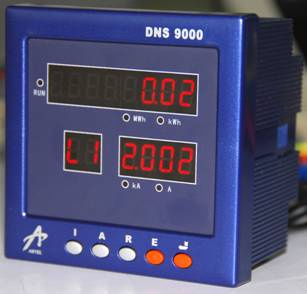
DNS 9000 energy meter: digital metering for single- and three-phase systems
The DNS 9000 energy meter (models DNS 9000, DNSS 9000 and DNS(X) 9000, trademark Artel, supplied through LOGGON TECH) is a digital energy meter for active, reactive and combined energy. It is intended for secondary measurement in single-phase, three-phase three-wire and three-phase four-wire systems, including unbalanced loads, in both high-voltage and low-voltage installations. Real-time measurement covers current, kWh and kvarh, and the meter provides multi-tariff metering together with RS485 (MODBUS) communication, an analog output, a remote signalling (digital) input and an energy pulse output. This page summarises what the instrument measures, how it is configured, and where it is typically installed; the full datasheet is available from the contact page.
What it measures and does
The DNS 9000 energy meter is a digital energy meter for industrial metering points. Its core function is energy registration: it accumulates active energy (kWh), reactive energy (kvarh) and combined energy, and it displays and transmits real-time current values alongside the accumulated registers. Because reactive energy is metered separately, the instrument can be used at metering points where power factor and reactive consumption are billed or monitored, not only where active energy is recorded.
Multi-tariff metering allows consumption to be registered in separate tariff registers, so time-of-use billing or internal cost allocation can be carried out from a single instrument rather than from several single-register meters. The RS485 interface with MODBUS protocol allows the meter to be read by a PLC, RTU, gateway or energy management system over a twisted-pair bus. The analog output provides a proportional signal for a downstream control or recording device, the remote signalling (digital) input accepts an external status or control signal, and the energy pulse output delivers a pulse train proportional to accumulated energy for connection to a pulse counter, data logger or PLC high-speed input.
The meter is specified for secondary measurement in high- and low-voltage systems. The connection arrangement for the selected model — including any transformer operation and CT/VT ratios — follows the model's wiring documentation. The stated application scope includes unbalanced loads, which matters in three-phase four-wire distribution boards where single-phase loads are connected between phase and neutral and phase currents are not equal.
Key features
- Active, reactive and combined energy measurement in one instrument.
- Real-time measurement of current, kWh and kvarh.
- Multi-tariff metering with separate tariff registers.
- RS485 communication using the MODBUS protocol.
- Analog output for proportional signal transmission.
- Remote signalling (digital) input for external status signals.
- Energy pulse output for counter, logger or PLC connection.
- Application in single-phase, three-phase three-wire and three-phase four-wire systems, including unbalanced loads.
- Suitable for secondary measurement in high-voltage and low-voltage systems.
- Designed and documented with reference to IEC61000, IEC1010 and EN61010; the manufacturer's documentation states manufacture under an ISO 9001 quality management system.
Specifications
The table below lists the data published for the DNS 9000 series. Items not listed here, including accuracy class and housing dimensions, are not stated in this summary; request the datasheet for the complete specification.
| Product | Digital Energy Meter DNS 9000 |
|---|---|
| Model numbers | DNS 9000 / DNSS 9000 / DNS(X) 9000 |
| Trademark | Artel |
| Origin | Shenzhen, China |
| Brand / origin | Artel trademark, Shenzhen, China |
| Energy quantities | Active energy, reactive energy, combined energy |
| Real-time measurement | Current (I), kWh, kvarh |
| Tariff function | Multi-tariff metering |
| Communication | RS485, MODBUS protocol |
| Analog output | Provided |
| Digital input | Remote signalling input |
| Pulse output | Energy pulse output |
| System types | Single-phase; three-phase three-wire; three-phase four-wire; unbalanced loads |
| Measurement type | Secondary measurement in high-voltage and low-voltage systems |
| Documentation references | IEC61000, IEC1010, EN61010 |
| Quality system | Manufacturer documentation states production under an ISO 9001 quality system |
Options and configuration
Three model designations are listed for this series: DNS 9000, DNSS 9000 and DNS(X) 9000. The published summary does not assign differences between these designations, so the required variant should be confirmed against the datasheet and the order code before purchase. When preparing an enquiry, state the following:
- System type: single-phase, three-phase three-wire or three-phase four-wire.
- Connection arrangement per the selected model's wiring documentation, and the CT/VT ratios where applicable.
- Tariff structure required at the metering point.
- Communication requirements: RS485 bus length, protocol use and the reading device (PLC, RTU, gateway or energy management system).
- Use of the analog output, digital input and pulse output, including the downstream device for each.
- Panel space and wiring arrangement at the installation point.
For MODBUS integration, agree the register map, baud rate, parity and device address with the controls engineer before commissioning, and terminate and bias the RS485 bus according to the installation standard in use.
Applications
The DNS 9000 energy meter is used where active and reactive energy must be recorded together and the data must be available to a control or monitoring system. Typical installation points include low-voltage distribution boards in commercial and industrial buildings, sub-metering of individual production lines or departments for internal cost allocation, transformer-operated metering in high-voltage systems, and utility or landlord metering in multi-tenant facilities. The RS485 (MODBUS) interface and pulse output suit plants that already run a PLC, SCADA or energy management platform and want the meter integrated into an existing data path rather than read locally. Multi-tariff registration supports sites on time-of-use tariffs or with internal peak/off-peak accounting.
FAQ
Can the DNS 9000 energy meter be connected directly, or does it require transformers?
The stated application scope is secondary measurement in single-phase, three-phase three-wire and three-phase four-wire systems in both high-voltage and low-voltage installations. The connection arrangement for the selected model follows its wiring documentation, so confirm it with the manufacturer when ordering.
What communication interface does the meter provide?
The meter provides an RS485 interface using the MODBUS protocol. It also provides an analog output, a remote signalling (digital) input and an energy pulse output. The register map and communication parameters should be obtained from the datasheet before integration.
Does it meter reactive energy as well as active energy?
Yes. The DNS 9000 registers active energy, reactive energy and combined energy, and provides real-time measurement of current, kWh and kvarh. Reactive energy is held in its own registers, so power factor related consumption can be monitored or billed separately from active energy.
What standards and quality system apply to the DNS 9000?
The published documentation references IEC61000, IEC1010 and EN61010. The manufacturer's documentation states that the meter is manufactured under an ISO 9001 quality management system. Accuracy class and other detailed characteristics are not stated in this summary; request the datasheet for the complete data.
For the full datasheet, the model and option list, the MODBUS register map and the documentation for the Artel DNS 9000 series, contact LOGGON TECH through the contact page and state the system type, connection mode and communication requirements of the intended installation.