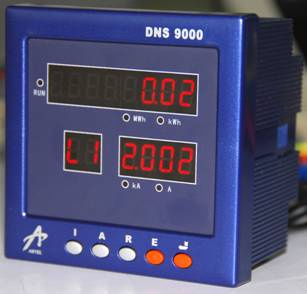
kWh meter for feeder, tenant and sub-metering installations
A kWh meter is the billing and accounting element of an electrical installation: it converts measured voltage and current into accumulated active energy, and in most industrial systems it is the figure against which consumption is invoiced, allocated to tenants or reconciled between feeders. The LOGGON TECH DNS 9000 series is a digital kWh meter range built for this role. It meters kWh and kvarh in real time, holds multi-tariff registers, and provides RS485 (MODBUS) communication, analog output, remote signalling input and energy pulse output. The series covers single-phase, three-phase three-wire and three-phase four-wire systems, including unbalanced loads, and is intended for secondary metering in high- and low-voltage systems.
Overview: where a kwh meter is installed and what it is asked to do
In plant practice the kwh meter sits at the boundary between the utility supply and the load, or between one part of the installation and another. Three duties recur:
- Feeder metering. Energy is recorded per outgoing feeder so that consumption can be assigned to a process line, building or department. The meter must hold its register through supply interruptions and remain readable locally for periodic inspection.
- Tenant and sub-metering hardware. Landlords, industrial parks and shared facilities use sub-meters to divide a single utility bill among occupants. Here the tariff register structure matters as much as the total: consumption in different time bands is priced differently, so the meter must accumulate each band separately.
- Pulse output to legacy counters and PLC. Many plants already have electromechanical counters, PLC totalisers or building-management inputs that accept a pulse train rather than a serial protocol. The energy pulse output lets a new meter feed existing equipment without replacing it.
For three-phase feeders the 3 phase kwh meter variant is the normal choice, since it measures all three phases and remains correct when the load is unbalanced. Single-phase units cover lighting circuits, small distribution boards and individual tenant supplies. Because the DNS 9000 series meters both kWh and kvarh, the same device can support active-energy billing and reactive-energy assessment without a second instrument.
Models in this range
The range is designated DNS 9000, with variants DNS 9000, DNSS 9000 and DNS(X) 9000. The series is documented collectively; the suffix indicates the variant within the series, and each variant's communication and I/O fit-out is confirmed against the current datasheet at the ordering stage.
| Series | DNS 9000 / DNSS 9000 / DNS(X) 9000 |
|---|---|
| Measured quantities | kWh and kvarh, metered in real time |
| Registers | Multi-tariff energy registers |
| System types | Single-phase; three-phase three-wire; three-phase four-wire; suitable for unbalanced loads |
| Application | Secondary metering in high- and low-voltage systems |
| Communication | RS485 (MODBUS) |
| Outputs and inputs | Analog output; energy pulse output; remote signalling input |
| Standards referenced | IEC61000, IEC1010, EN61010 |
| Quality system | ISO 9001 (per manufacturer documentation) |
How to select
Selection starts with the circuit, not the meter. Confirm the system configuration first: single-phase, three-phase three-wire or three-phase four-wire. A four-wire feeder with significant single-phase loading will be unbalanced, and the meter must be specified for that condition. Next, establish how the meter is connected: it is applied as secondary metering, and the connection arrangement and CT/VT ratios follow the selected model's wiring documentation; the transformer ratios then set the multiplier applied to the meter reading.
Define the register requirement. If energy is billed at a single rate, a total kWh register is sufficient. If time-of-use tariffs apply, specify multi-tariff registers and confirm how tariff switching is controlled in the installation. Where reactive energy is charged or monitored, note that kvarh is metered by the same device.
Finally, list the interfaces the installation actually needs: RS485 (MODBUS) for a monitoring system, analog output for a control or indication loop, remote signalling input for status or control signals from external equipment, and energy pulse output for legacy counters or PLC totalisers. Specifying only the interfaces in use avoids unnecessary wiring and commissioning work.
Integration and communication
On the communications side, the DNS 9000 series uses RS485 with MODBUS, which allows meters to be connected in a bus arrangement and read by a PLC, energy management system or data logger. Address each meter individually on the bus and follow the manufacturer's wiring guidance for termination and cable routing; RS485 segments should be kept clear of power cabling to limit induced noise. The energy pulse output provides a pulse signal proportional to accumulated energy (output type per the current datasheet), suitable for driving existing counters or PLC inputs where a serial link is not available. The analog output delivers a continuous signal representing the measured quantity for trend recorders or analog control inputs. The remote signalling input accepts an external signal into the meter, useful where a status or control condition must be captured alongside the energy record.
The meter is documented against IEC61000, IEC1010 and EN61010, and the manufacturer's documentation states production under an ISO 9001 quality system. These references should be checked against the EMC and safety requirements of the specific project before installation.
FAQ
Can the DNS 9000 series be used for tenant sub-metering?
Yes. The series is intended for secondary metering and provides multi-tariff registers, so consumption can be allocated to tenants and split across tariff bands. The 3 phase kwh meter versions cover three-phase tenant supplies, and single-phase versions cover smaller circuits.
Does the meter measure reactive energy as well as kWh?
Yes. The DNS 9000 series meters both kWh and kvarh in real time. Active energy is available for billing, and reactive energy is recorded by the same device.
How does the meter connect to an existing PLC or counter?
Two routes are available. The RS485 (MODBUS) port allows serial reading by a PLC or monitoring system. The energy pulse output provides a pulse signal that legacy counters and PLC totaliser inputs can accept directly.
Is the meter suitable for unbalanced three-phase loads?
Yes. The series supports three-phase three-wire and three-phase four-wire systems and is suitable for unbalanced loads, which is the usual condition on four-wire distribution boards with single-phase branch circuits.
For a kwh meter specification, the practical sequence is to fix the system type, confirm secondary metering with the correct transformer ratios, decide the tariff register structure, and list only the interfaces the installation will use. The DNS 9000 series covers these requirements across single-phase and three-phase applications, with kWh and kvarh metering, multi-tariff registers, RS485 (MODBUS) communication, analog output, remote signalling input and energy pulse output. LOGGON TECH supplies the series for feeder metering, tenant and sub-metering, and pulse-based integration with existing plant equipment.