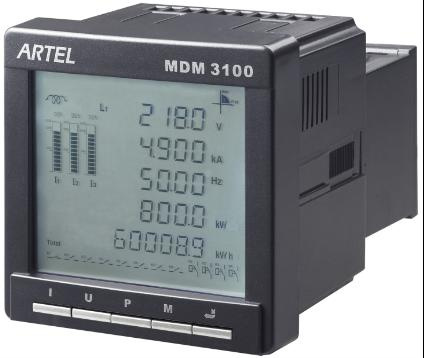
MDM3100 multifunction power meter
The MDM3100 multifunction power meter is a modular panel meter for three-phase electrical metering and monitoring in industrial switchgear, machine control cabinets and building distribution boards. It measures voltage, current, active, reactive and apparent power, power factor, frequency and energy, and provides RS-485 communication plus two energy pulse outputs as standard. The meter is an Artel-trademark product from Shenzhen, China, supplied through LOGGON TECH. Its modular architecture allows the user to add function modules — harmonic analysis, digital input, analog output, data storage, Profibus or Ethernet — to one base unit, with — per the manufacturer's historical catalogue — a maximum of four modules per meter (confirm against current ordering documentation). This page summarises what the MDM3100 multifunction power meter measures, how it can be configured, and the technical data needed for panel design and procurement.
What it measures and does
The meter acquires the three-phase system quantities required for energy management, load analysis and basic power quality checks. The measured parameter set covers:
- Voltage U and current I per phase
- Active power P, reactive power Q and apparent power S
- Power factor COS-PHI
- Frequency F
- Active energy kWh and documented active/reactive energy pulse outputs (reactive entry listed as kVAr in the manufacturer's capture; register availability per the datasheet)
Beyond live measurement, the standard unit records maximum and minimum values, which can be read back from the meter. It also records a sequence of events (SOE), which helps maintenance staff correlate trips, status changes and supply disturbances with a time-stamped event list during fault analysis.
Two energy pulse outputs are provided as standard: one for active energy and one for reactive energy. These outputs can feed a PLC counter input, an external energy logger or a building management controller, allowing the meter to be integrated into existing energy accounting systems without a communication gateway. The standard RS-485 interface carries the measured values and recorded data to a supervisory system over a twisted-pair bus.
Key features
- Modular design: base unit plus up to four function modules (per the historical catalogue; confirm current ordering), so the meter can be specified to the panel's actual requirements rather than a fixed feature set.
- Standard RS-485 communication for integration with PLCs, SCADA and energy monitoring software.
- Two energy pulse outputs as standard — active and reactive energy.
- Maximum and minimum value recording for later readout of peaks and dips.
- Sequence of events (SOE) recording for time-stamped fault and status analysis.
- Optional harmonic analysis module for power quality assessment.
- Optional 8-channel digital input module for remote signalling of breaker and contact status.
- Optional 4-channel programmable analog output module, 0-5 V or 4-20 mA, for retransmission to control systems.
- Optional data storage module for local logging.
- Optional Profibus and Ethernet modules for fieldbus and plant network connection.
- Auxiliary supply 85-265 V AC/DC as standard, with 24-36 V and 36-80 V AC/DC variants available per the historical catalogue.
- CE certification stated by the manufacturer; certificate available on request.
Specifications
The following data is taken from the model documentation. Parameters not listed here should be confirmed against the datasheet before ordering.
| Measured parameters | U, I, P, Q, S, COS-PHI, F, kWh, kVAr (notation as captured; register detail per datasheet) |
|---|---|
| Standard interface | RS-485 |
| Pulse outputs | 2 (active energy + reactive energy) |
| Recording | Max/min values; SOE (sequence of events) |
| Optional modules | Harmonic analysis; 8-channel digital input; 4-channel programmable analog output (0-5 V or 4-20 mA); data storage; Profibus; Ethernet |
| Maximum modules per meter | 4 (per historical catalogue; confirm current ordering) |
| Auxiliary supply | 85-265 V AC/DC standard; 24-36 V or 36-80 V AC/DC optional (historical catalogue) |
| Certification | CE — stated by the manufacturer's storefront; certificate available on request |
Options and configuration
Module and ordering information below comes from the model documentation. The historical catalogue ordering codes are:
- A/3100-101 — 8 digital inputs
- B/3100-102 — 4 relay outputs
- C/3100-103 — 4 analog outputs, 4-20 mA
- D/3100-104 — 4 analog outputs, 0-5 V
- E/3100-105 — data storage
- F/3100-106 — harmonic analysis
- G/3100-107 — storage plus harmonic analysis
- H/3100-108 — Profibus
- I/3100-109 — Ethernet
Because the historical catalogue lists a maximum of four modules per meter, the module combination should be fixed at the ordering stage and confirmed against current ordering documentation. When selecting, first define the communication path (RS-485 as standard, Profibus or Ethernet where the plant network requires it), then the I/O requirement (digital inputs for status signals, relay outputs for interlocking or alarms, analog outputs for retransmission to a PLC or DCS), and finally the analysis and logging functions (harmonic analysis, data storage). Note that the analog output module is ordered in either 4-20 mA or 0-5 V form, not both. The auxiliary supply variant must be stated separately, as 85-265 V AC/DC is standard and the 24-36 V and 36-80 V ranges are optional per the historical catalogue.
Applications
The MDM3100 multifunction power meter is suited to low-voltage distribution panels in factories, where it provides the metering layer between the switchgear and the plant monitoring system. Typical uses include:
- Sub-metering of individual production lines, compressors, chillers and other large loads for energy cost allocation.
- Main incoming metering in machine control cabinets, with pulse outputs feeding existing counters.
- Panel-level monitoring in building distribution boards, with RS-485 data collected by a supervisory system.
- Power quality investigation where the harmonic analysis module is fitted.
- Fault analysis using the SOE record and max/min values after a trip or supply disturbance.
- Retransmission of measured values to a PLC or DCS via the programmable analog output module.
FAQ
How many function modules can be added to one MDM3100?
Four modules per meter, per the manufacturer's historical catalogue; confirm against current ordering documentation. The module combination is fixed at ordering; plan the communication, I/O and analysis requirements before selecting the ordering code.
What communication interfaces are available?
RS-485 is fitted as standard. Profibus (H/3100-108) and Ethernet (I/3100-109) are available as optional modules from the historical catalogue.
What auxiliary supply does the meter require?
The standard auxiliary supply is 85-265 V AC/DC. Optional 24-36 V and 36-80 V AC/DC variants are listed in the historical catalogue; state the required variant when ordering.
Is the analog output module available in both current and voltage form?
Yes. It is ordered as either 4-20 mA (C/3100-103) or 0-5 V (D/3100-104), four channels, programmable. The two forms are separate ordering codes.
For the full datasheet, terminal diagrams and the CE certificate, contact LOGGON TECH through the contact page and state the required module combination and auxiliary supply variant. The datasheet should be used to confirm dimensions, wiring and parameter ranges before panel design is finalised.